The engineer who still uses the tape machine he was trained on in 1974.
Half a working life later, the Studer is still in the corner of the studio, still calibrated, still used at least once a week. We spent an afternoon with him and the machine.
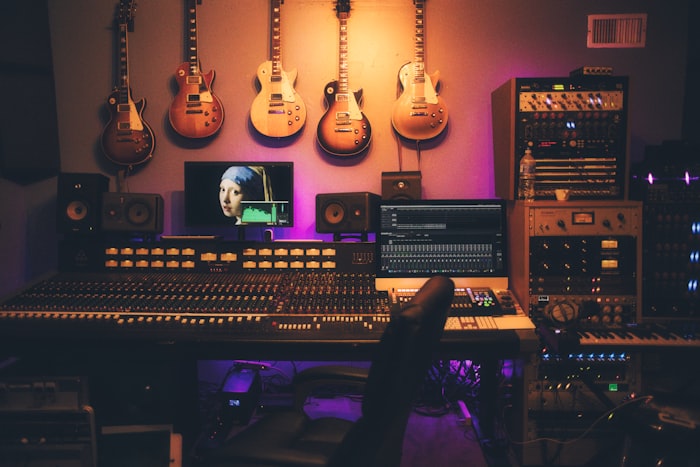
The studio is on the upper floor of a small commercial building near the centre of a Midlands town that has, in the past two decades, mostly given up on having a music industry. The lift does not work. The stairwell smells faintly of damp. The door at the top, which has no sign on it, opens into a single large room: control desk against the back wall, two pairs of speakers on stands, a substantial collection of outboard equipment in racks, and — at the side of the room, on its own dedicated cabinet — a large reel-to-reel tape machine.
The machine is a Studer of the early 1970s. The engineer who owns it, and who has been running this studio for the past nineteen years, was trained on a machine of this exact model in 1974, when he was a junior at a recording facility that no longer exists. The machine in the corner is not the same physical machine — he could not, by his own account, afford that one — but it is the same model, in similar condition, calibrated to the same specifications. He has owned it since 2007.
What he uses it for
The studio's commercial work, like the commercial work of every studio I have visited in the past five years, is mostly digital. The desk is a substantial modern unit with analogue summing and a digital interface. The outboard is a mixture of vintage and modern. The day-to-day signal chain, for the work that pays the bills, runs into a contemporary digital audio workstation.
The tape machine, he tells me, is used at least once a week. Sometimes it is used for a mix-down: a finished digital mix, sent to tape at half-inch two-track, and back to digital with whatever the tape has added or removed in the process. Sometimes it is used for a particular instrument that the client has decided wants the tape treatment — typically drums, occasionally a vocal, very occasionally a whole rhythm section. Sometimes it is used because the client has paid for an hour of tape time and is going to use it whether it suits the music or not.
What it does to the sound
I asked him to explain, in his own terms, what the tape does. He paused for a long time before answering. The reluctance, he said, was that the honest answer was both technical and slightly mystical, and he did not like to say things that sounded slightly mystical. He gave me, eventually, the technical answer first.
Tape, recorded at the levels he runs the machine at, adds a small amount of harmonic distortion to the signal. The distortion is mostly even-order, which is to say, harmonically related to the original signal in ways the ear finds pleasant rather than unpleasant. Tape also has a frequency response that is not flat: there is a gentle high-frequency roll-off, the exact shape of which depends on the tape formulation and the bias setting, and a slight low-frequency lift that varies with tape speed. The overall effect is a small, characteristic colouration that is, by careful adjustment, made to sit in a particular relationship to the music.
"The technical answer is that the tape adds even-order harmonic distortion and a particular frequency response. The honest answer is that the tape makes the music sound like a record."
The slightly mystical answer, when he came to it, was more interesting. The tape, he said, makes the music sound like a record. This is not a tautology, and the way he said it suggested he had thought about it for a long time. A digital mix, played back through a good monitoring system, sounds like a digital mix. The same digital mix, sent through the tape machine and returned to digital, sounds — he insists, and a small but consistent number of his clients agree — like a record. Something about the tape, beyond what the measurements account for, makes the music feel like a finished, manufactured artefact rather than an unfinished work in progress.
What it costs to keep running
The machine is expensive to maintain. The transport requires servicing every eighteen months or so by a specialist who travels between the surviving studios with this kind of equipment. The heads have to be cleaned before each session and demagnetised regularly. The capstan and pinch roller have to be checked for wear. The electronics, which are in remarkably good condition for their age, have nevertheless had a number of components replaced over the years as parts have failed.
Tape itself is the largest ongoing cost. A reel of half-inch tape, in 2026, costs roughly seventy pounds and lasts — depending on use — between three and ten sessions. The engineer estimates he spends somewhere between two and three thousand pounds a year on tape alone.
The studio is, in straightforward economic terms, a worse business with the tape machine than it would be without it. He is, he says, comfortable with this. The machine pays for itself in repeat work from a small core of clients who book the studio specifically for the tape, and the broader effect of having it in the room — both on the work he attracts and on the work he produces — is, in his estimation, worth what it costs.
What he says about training
I asked him, towards the end of the afternoon, whether he had ever trained anyone else on the machine. He had, twice, both junior engineers who had worked at the studio for a period of years. Both had subsequently moved to other studios. Both, he said, occasionally rang him to ask questions about tape that they could not find answers to on the internet.
He is not, he insists, sentimental about the format. He does not believe that all digital recording is inferior. He has, in his own time, made several records he is proud of that have never been near a tape machine. The Studer in the corner is not, for him, a statement of principle. It is a tool that does a particular job well, that he was taught to use as a young man, and that he has chosen to continue using for half a working life.
The next session is on Thursday. He will, before it starts, clean the heads and check the bias. The tape will be loaded. The client will arrive at two. Whether the tape is used or not will depend on the music, but the machine will be ready.