Small speakers, large rooms — a fortnight of compromise.
What happens when you put a pair of well-regarded bookshelf monitors in a room they were never designed for. Spoiler: mostly disappointing, but instructive about what a small speaker actually does.
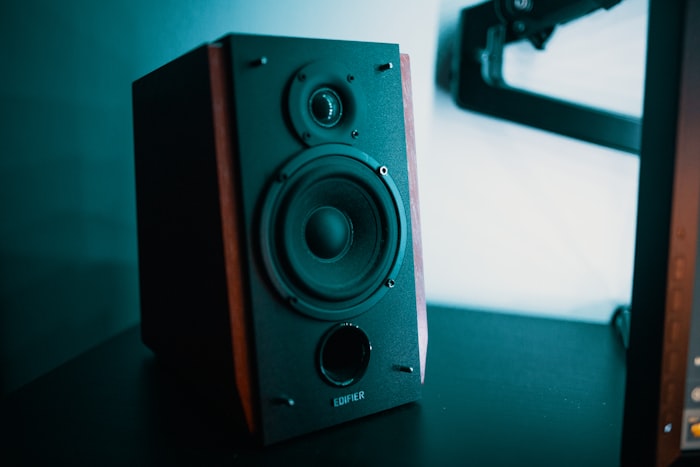
The speakers under review are a pair of small two-way monitors of recent manufacture, from a respected British maker, with a published response that is unusually flat and a published low-frequency limit of around fifty hertz. They are the kind of speaker that wins design awards and gets recommended to readers setting up a serious listening system in a small flat. They are, by the standards of their category, very good speakers.
The two rooms in which I have spent six weeks listening to them are not small. The first is the listening room at our offices in Mansfield — a converted upstairs reception room of roughly twenty-eight square metres, with a sloping ceiling that adds to the volume but not in a useful way. The second is my own sitting room, which is about twenty-two square metres but acoustically less well-behaved than the first.
What the brochure says
Manufacturers, by trade necessity, are not in the business of telling you that their speakers will not work in your room. The brochure for these speakers includes a sentence about being "suitable for medium-sized rooms," which is — depending on how one reads it — either accurate or generously optimistic. The recommended amplifier power range tops out at around eighty watts per channel, which is plenty for a small room and marginal for a large one.
What the brochure does not say is that small two-way speakers, regardless of brand or price, have inherent limitations that no amount of clever crossover design can engineer around. The cone area is small, so the air movement is small, so the perceived weight of the bottom octaves in a large room is, by physics, going to be modest. The dispersion pattern is narrow enough that the room's reverberant field, in a large room, contributes more to the overall sound than the speakers themselves.
What I heard, in week one
The first impressions, in the larger room, were mostly disappointing. The speakers sounded, frankly, lost. The imaging was vague. The bottom octaves were almost absent. The midrange — which on these speakers, in a smaller room, is genuinely excellent — was diffused by the reverberation of the larger space. The overall effect was of speakers that knew they were in the wrong place and were not going to pretend otherwise.
I considered, briefly, whether the equipment chain was at fault. I substituted the amplifier (a known-good integrated of recent manufacture), the source (a turntable that had performed well in the room with other speakers), and the cabling (boring, well-made, conventional). The results did not change.
What I heard, after two weeks
The interesting bit happened in week two, after I had moved the speakers to within about eighty centimetres of the rear wall and reduced my listening distance to roughly two-and-a-half metres. This is, by any reasonable standard, too close. It puts the speakers and the listener in an arrangement they were not designed for, and most reviewers would not write about it.
The change, however, was substantial. With the speakers near a boundary, the bass returned — not because the speakers were producing more bass, but because the reinforcement from the rear wall made the bass that the speakers were already producing more present at the listening position. With the listener closer, the direct sound dominated the reverberant field, and the imaging recovered. The midrange — that excellent midrange — came back into focus.
The speakers, in their preferred configuration, are excellent. The mistake was mine, in trying to make them serve a room they were never designed to serve.
What I learned
The lesson, which I had known in the abstract but had not properly understood until I sat with it for six weeks, is that small speakers in large rooms are not a hi-fi system. They are a near-field monitoring system installed in the wrong location. The equipment is not, in itself, bad. The configuration is bad.
There are, broadly, two ways to resolve this. The first is to give the small speakers the conditions they need: a near-field listening position, a nearby boundary for low-frequency reinforcement, and a modestly damped room. In those conditions, these particular speakers are very good, and I will write a more conventional review of them in a future issue when I have set up a proper room for the purpose.
The second is to accept that the large room needs larger speakers. This is not, in my experience, a controversial position among people who have listened to enough systems in enough rooms to have developed a sense of what works. The mid-range to large-room listener is, in 2026, slightly out of fashion. The dominant aesthetic in the press is towards small, well-controlled monitors of the kind I have just reviewed. The reality of most British sitting rooms is that they are larger than that aesthetic accommodates.
A note on the speakers themselves
I want to be clear about something, before closing: the speakers under review are not at fault. They are, in their preferred configuration, excellent. The mistake was mine, in trying to make them serve a room they were never designed to serve. They will return to a smaller room and will be reviewed there in due course.
The broader lesson — that the room is, in almost all cases, more determinative of system performance than any single component — is one we have been repeating in these pages for some time. It is worth, occasionally, demonstrating it the hard way.